What If Your Compiler Is the Attacker?
You read the source code. It looks clean. You compile it and ship it. This is a source-code audit, an important check in software security.
But source code isn't what runs on your computer. A compiler translates it into an executable, the raw instructions your machine actually runs. The audit assumes the compiler is honest. What if the compiler is the attacker?
That question has a name: the trusting trust attack, from Ken Thompson's 1984 paper "Reflections on Trusting Trust." Thompson showed a compiler could be secretly modified to slip hidden malicious behavior into the programs it builds, and to keep copying that behavior into every future version of itself, even after its own source code looks clean. Source code can look safe while the software actually running is compromised.
What is the trusting trust attack?
A trusting trust attack is a supply chain attack against the build toolchain itself. Instead of placing a backdoor in the source code of an application, an attacker modifies the compiler binary so it recognizes particular source patterns and silently changes the generated machine code.
The attack becomes especially persistent when the modified compiler can also recognize its own source code. When compiling a new version of itself, it injects the same hidden behavior into the next compiler binary.
That creates two separate effects. The first is target-program injection: when compiling a chosen program, such as an authentication component, the compiler adds a malicious payload to its binary output. The second is compiler self-replication: when compiling its own source code, the compiler inserts the logic required to keep injecting that payload into every future compiler generation.
After this cycle is established, removing suspicious code from the compiler source is not necessarily enough. A compromised compiler can rebuild an apparently clean compiler source tree into another compromised binary.
Why clean source code is not always proof of clean software
Normally, we trust that source code corresponds to the executable created from it. In simplified form, the expected process looks like this:
- We inspect source code.
- We compile it.
- We assume the binary reflects that reviewed source.
A compiler backdoor attacks the second step. The source may be harmless, while the compiler emits an altered executable after the review is finished.
This is why a source audit alone cannot fully answer the question, "Can we trust this binary?" To answer that question, we also need confidence in the compiler, its dependencies, the build environment, and the chain of tools used to create them.
How self-hosting creates a trust chain
Many programming languages are self-hosted. This means their compiler is written in the same language that it compiles. A C compiler, for example, can be implemented in C.
Self-hosting is practical and common, but it produces a bootstrapping question: how was the first usable compiler created?
Compiler lineages typically begin with simpler tools and older languages. Early assemblers converted assembly instructions into machine code, and the earliest programs could require humans to translate instructions into the numerical opcodes a machine could execute. Later tools made it possible to compile increasingly sophisticated languages and eventually compile their own source.
Each stage inherits trust from the previous stage. If a trusted compiler builds the next compiler, the resulting binary may inherit any behavior embedded in its parent compiler, including behavior that no longer appears in source code.
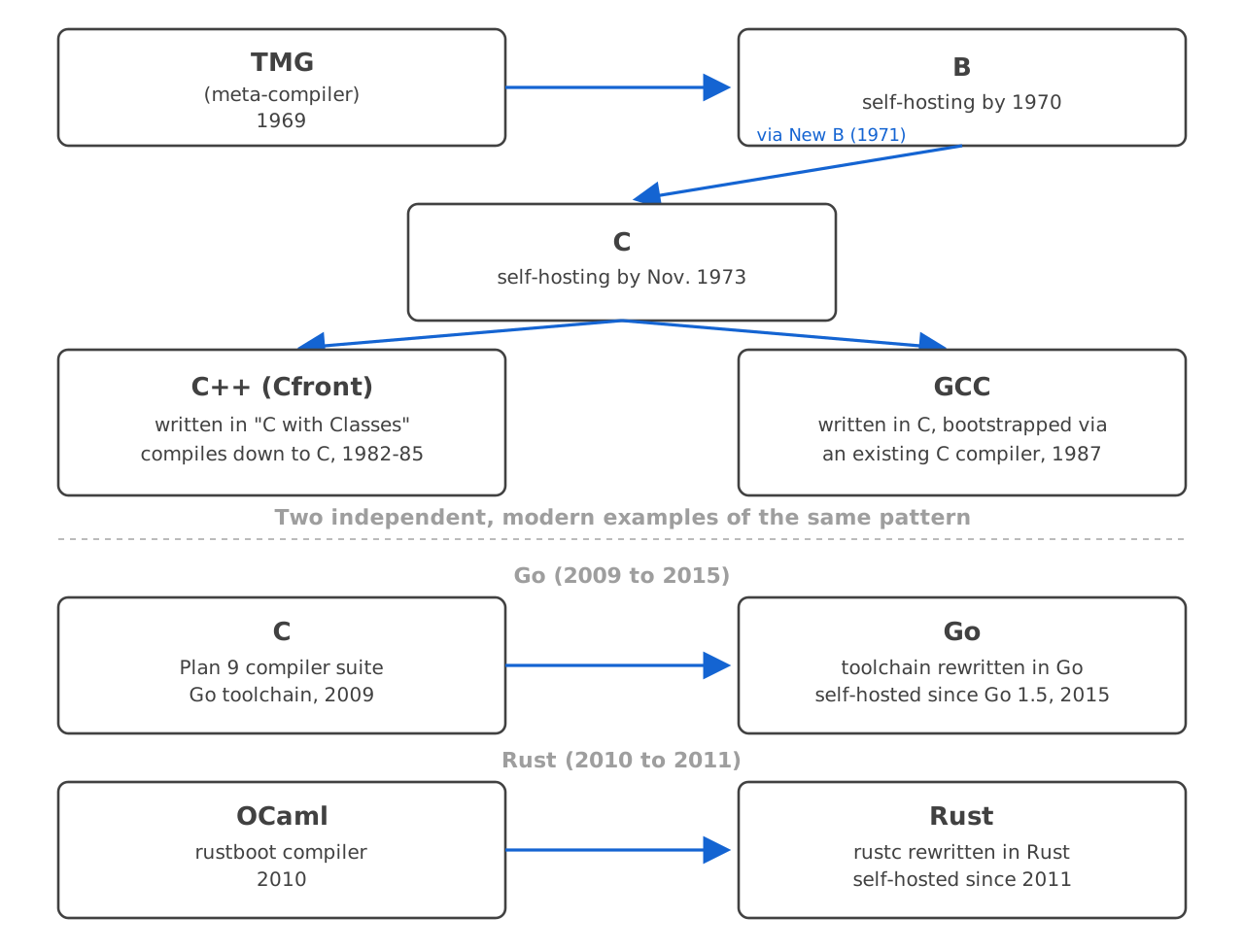
[Source: compiled by Yoschanin from the primary and historical sources listed in the References section]
This is not a chart of which language influenced another's design. It traces which language actually built each compiler's binary, and the exact point each one stopped depending on an outside language and started building itself. The pattern repeats from Thompson's original C compiler through to Go and Rust today.
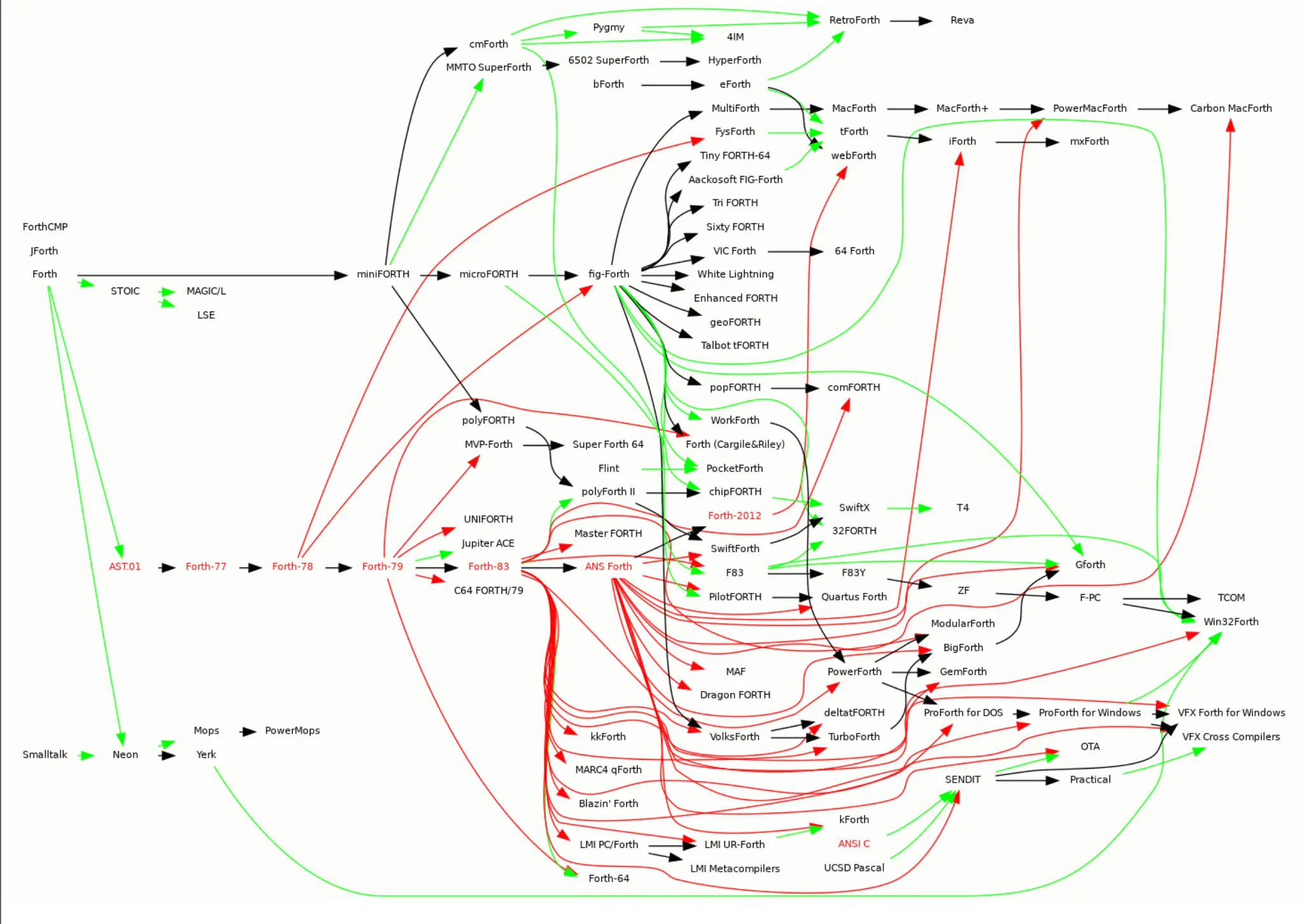
[Source: https://www.complang.tuwien.ac.at/forth/family-tree/]
Even a single self-hosted language accumulates a sprawling lineage, as this family tree of Forth implementations shows. Each new dialect inherits from earlier ones, illustrating how far a trusted (or compromised) build path can reach.
Why quines help explain the problem
A quine is a program that outputs a copy of its own source code when it runs. It is a programming exercise that demonstrates how software can describe and reproduce itself.
For example, a C quine stores a representation of its own source in a string and prints that representation with carefully chosen formatting. It must handle characters such as quotation marks and line breaks correctly so its output matches the original source exactly.
The key idea is not that quines are malicious. They are usually educational. Their value here is conceptual: they show how code can carry enough information to recreate itself.
A malicious compiler does something more subtle. Rather than printing its own source, it recognizes the source code it is compiling and produces altered output. When the input belongs to the compiler itself, it can reproduce the hidden modification in the next generation.
A simplified trusting trust attack flow
Think of the threat as a conditional transformation performed during compilation: the compiler checks what it is compiling and silently alters its output only when it recognizes a specific target, whether that target is a sensitive program or the compiler's own source. The walkthrough later in this article traces that logic as an example.
The payload does not need to alter every program. A selective backdoor is more difficult to notice because normal builds can behave as expected. The compiler can reserve malicious behavior for specific source structures or targeted applications.
Why reverse engineering and source audits are both difficult
There are two major places to investigate a suspected compiler compromise. The compiler binary itself may require reverse engineering with tools such as Ghidra or IDA. The binaries the compiler produces may also need binary-level analysis, since the malicious insertion happens after source code is compiled.
Source-code review remains valuable, but it cannot reveal changes introduced only in the generated executable. Meanwhile, manual analysis of compiler binaries is difficult, and modern compiler projects are large enough that complete human review is rarely realistic. For example, the LLVM Project on GitHub contains over 35 million lines of code as of late 2024, while the GNU Compiler Collection (GCC) contains roughly 15 million lines of code as of 2019, the most recent public count.
Obfuscation can make the problem harder still. A proof of concept might encode characters as decimal ASCII values or hide logic inside arrays and transformations. Real-world obfuscation can be much more sophisticated, increasing the cost of identifying suspicious behavior.
Why compiler infrastructure expands the blast radius
The potential impact is not limited to one language. Modern ecosystems depend on shared compiler infrastructure and long chains of build dependencies.
LLVM is a clear example. Its infrastructure directly supports C, C++, and Objective-C through Clang, and it is also used by language toolchains such as Swift, Rust, and Fortran. A compromise in broadly shared infrastructure could therefore affect far more than a single codebase or programming language.
Consider an iOS application. A developer may focus on Swift or Objective-C rather than C, yet the build process can still rely on Clang and LLVM components underneath. Dependencies in a toolchain are often invisible during normal development, which is exactly why they need explicit security consideration.
A real-world example: XcodeGhost
The idea of malicious build tooling is not purely theoretical. In 2015, XcodeGhost involved a trojanized version of Apple's Xcode development environment. Developers used the infected tooling to build legitimate iOS applications, while the compromised environment added malicious code to the final apps.
The developers did not need to intentionally include harmful code in their projects for the affected applications to carry it. This illustrates the core supply chain lesson: trusted development tools can become a path for distributing unwanted behavior into otherwise legitimate software.
How an attacker would actually carry this out
-
Modify the compiler's source to add two pieces of malicious logic.
-
A check that recognizes when the compiler is compiling the login program, and inserts a hardcoded password backdoor into the resulting binary.
-
A check that recognizes when the compiler is compiling itself, and re-injects both of these behaviors into whatever new compiler binary it produces.
-
-
Compile the modified source using an ordinary, legitimate compiler.
This produces a new compiler binary with both backdoors baked into its compiled logic, the malicious behavior now exists as machine code, not as visible source text.
-
Revert the source back to its original, clean state.
The attacker deletes every trace of the malicious changes from the source tree. What's left is identical to the legitimate, upstream version. It would pass any code review, diff check, or audit, because there is genuinely nothing suspicious in it anymore.
-
Distribute the compromised binary and let it self-perpetuate.
Can we defend against a compromised compiler?
There is no simple universal solution, but there are meaningful mitigations. The most important technique discussed for this specific problem is diverse double compiling, often shortened to DDC.
How diverse double compiling works
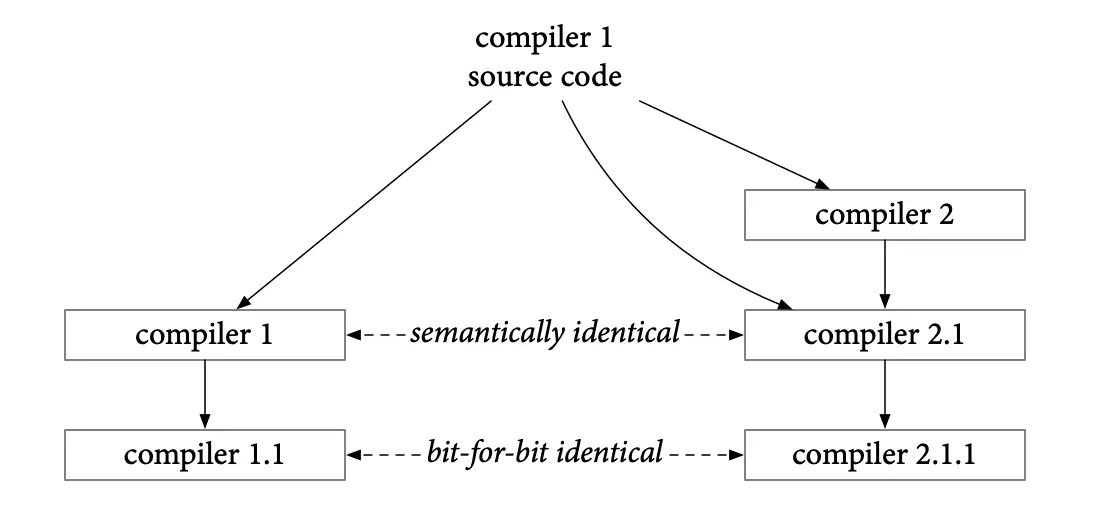
DDC checks whether a suspect compiler binary was faithfully built from its claimed source code, with nothing hidden injected by a compromised build chain. It works by building the same source code down two independent paths, then checking where those paths should, and should not, agree.
| Label | What it is |
|---|---|
| Compiler 1 | The suspect compiler binary already in circulation, the one you don't fully trust yet. |
| Compiler 2 | A completely separate, already-trusted compiler: different codebase, different authors, no shared lineage with compiler 1. |
| Compiler 2.1 | The binary produced when compiler 2 compiles compiler 1's claimed source code. |
| Compiler 1.1 | The binary produced when compiler 1 compiles its own source code again, one more self-hosting generation. |
| Compiler 2.1.1 | The binary produced when compiler 2.1 compiles that same source code again. |
-
Get compiler 2: a totally unrelated compiler you already trust.
-
Use compiler 2 to compile the suspect compiler's source code. The result is compiler 2.1. Because an independent, unrelated tool built it, compiler 2.1 has no way to inherit any backdoor that lives only in compiler 1's own lineage.
-
Compare compiler 1 to compiler 2.1. They should be semantically identical, since both were built from the same source, just by two different compilers.
-
Compile the same source code once more, using each compiler in turn: compiler 1 compiles it to produce compiler 1.1, and compiler 2.1 compiles it to produce compiler 2.1.1.
-
Compare compiler 1.1 to compiler 2.1.1 byte-for-byte.
If compiler 1.1 and compiler 2.1.1 are bit-for-bit identical under the necessary controlled conditions, that provides strong evidence that the compiler source corresponds to the compiler binary being evaluated, rather than being altered by a hidden, self-propagating modification. A backdoor that only re-inserts itself when compiler 1 recognizes its own source would show up right here: compiler 2.1 never carried that hidden logic, so compiler 2.1.1 would not match compiler 1.1. However, if the source code itself is contaminated, DDC does not prevent a malicious binary from being produced. Manual inspection of the source code is still needed.
[Source: https://research.swtch.com/nih]
Diverse double compiling traces two independent build paths from the same source, then compares them for semantic identity and bit-for-bit identity to catch a self-propagating compiler backdoor.
Important limitations of DDC
DDC is powerful, but it is not effortless. It depends on having an appropriately independent trusted compiler, repeatable builds, controlled build settings, and a valid comparison process. Modern compiler builds can include environmental differences, generated files, timestamps, and other factors that complicate bit-for-bit reproducibility.
In other words, DDC reduces a critical trust problem, but implementing it correctly is a serious engineering task.
Bootstrapping from a small trusted compiler
Another theoretical approach is to begin with a very small compiler that can be carefully inspected and trusted, then use it to build progressively larger compilers. This attempts to create a clean lineage from a small and understandable starting point.
The challenge is scale. Modern toolchains are complex, and building a complete independently verified lineage is far beyond what most teams can do alone. Still, the idea shows a practical principle: smaller trusted computing bases are easier to reason about than enormous opaque dependency chains.
Practical steps for software teams
You cannot audit every compiler dependency or build every tool from scratch, but you can control who touches your build pipeline and what it pulls in. Start here:
Use a build-toolchain security checklist
- Acquire compilers and IDEs from trusted sources. Avoid unofficial, altered, or poorly verified downloads.
- Track toolchain versions. Record compiler, linker, SDK, and build environment versions used for release builds.
- Protect build systems. Apply access controls and limit who can change compiler settings, build scripts, and release pipelines.
- Prefer reproducible builds where feasible. Rebuilding the same source into identical artifacts makes unexpected differences easier to investigate.
- Validate release artifacts. Compare builds, verify hashes, and use controlled release processes.
- Audit dependencies, not only application code. Build tools, SDKs, CI environments, package systems, and compiler infrastructure are all part of the supply chain, the same scope a secure code review engagement should cover.
- Investigate unusual binary behavior. A clean source tree should not automatically end an investigation if released binaries behave unexpectedly.
Common misconceptions about compiler backdoors
"Open source makes this impossible."
Open source makes review and independent rebuilding possible, which is valuable. But source availability alone does not prove that a downloaded compiler binary was built faithfully from that source.
"Only C programs are affected."
Not necessarily. Compilers and language implementations frequently rely on shared infrastructure. A compromise in foundational tooling can propagate through toolchains used by many languages and platforms.
"A normal code audit would catch it."
Not if the malicious behavior exists only in a compiler binary and is inserted during compilation. An audit can show that application source is clean while the output binary remains altered.
"We can just inspect the assembly output."
Assembly inspection can help in some cases, but it is not a complete answer. A malicious compiler could behave differently depending on its output mode, and the final executable is still the artifact that must be trusted. A compiler can detect a -S invocation (i.e., someone asking to see the assembly, almost certainly to inspect or audit it) and honestly emit clean assembly there, then insert the backdoor only on a normal compile-to-binary invocation, the mode that actually produces what gets shipped and executed.
Trust does not end at your source code
Software trust does not begin and end with application source code. Compilers, build systems, SDKs, and inherited infrastructure are part of the security boundary too.
You have never asked which compiler built your build, and it points straight at the one link in the chain a source-code audit was never built to catch.
References
- LaurieWired, "The Original Sin of Computing...that no one can fix", YouTube. This article took heavy inspiration from this video.
- "Forth Family Tree", Institute of Computer Languages, TU Wien.
- Wikipedia, "B (programming language)".
- Wikipedia, "C (programming language)".
- Wikipedia, "Cfront".
- Wikipedia, "GNU Compiler Collection".
- The Go Authors, "Go 1.5 Bootstrap Plan", Go project design proposals.
- The Rust Project,
src/boot/README, rust-lang/rust repository (historical). Confirms rustboot was written in OCaml and rustc in Rust. - David A. Wheeler, "Fully Countering Trusting Trust through Diverse Double-Compiling", PhD dissertation, George Mason University, 2009. The original DDC paper.
- Russ Cox, "Running the 'Reflections on Trusting Trust' Compiler", research!rsc, October 25, 2023.
- Ken Thompson, "Reflections on Trusting Trust", Communications of the ACM, Vol. 27, No. 8 (August 1984), pp. 761-763. Delivered as the 1983 ACM A.M. Turing Award Lecture.
Related Reconix Services
- Secure Code Review: manual and tool-assisted review of your application source, understanding that a clean result answers only half the trust question if the compiler and build chain go unexamined.
- Security Audit: assessment of your build environment, CI/CD pipeline, and toolchain configuration, the layer a source-code review alone cannot reach.
- Cybersecurity Consulting: guidance on hardening build pipelines, verifying toolchain provenance, and adopting reproducible-build practices.
- Penetration Testing: hands-on testing of your deployed applications and infrastructure to find what static review and audits miss.