Vulnerability Assessment vs. Penetration Testing: What's the Difference and Which Do You Need?
"We did a VA scan, so we're covered."
We hear this regularly from IT teams that believe a quarterly vulnerability scan satisfies their penetration testing requirement. It does not, and understanding the difference matters because regulators, auditors, and attackers all know the distinction.
This article explains exactly how vulnerability assessments and penetration tests differ, when you need each, and how they work together in a mature security program.
The Core Difference
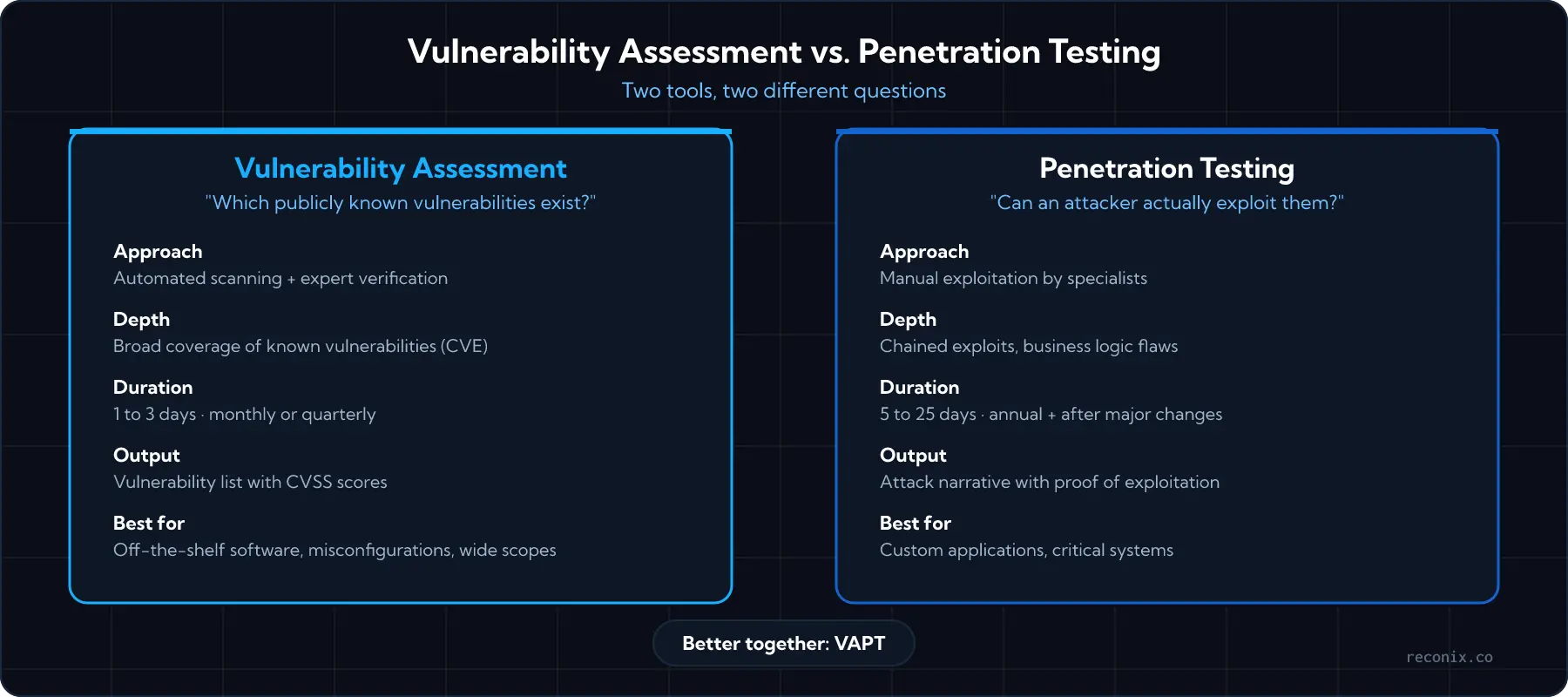
Vulnerability Assessment (VA) answers: "Which publicly known vulnerabilities exist in our systems?"
Penetration Testing (Pentest) answers: "Can an attacker actually exploit those vulnerabilities to cause business harm?"
A vulnerability assessment is broad and automated. It scans your systems against a database of known vulnerabilities and reports what it finds. Think of it as a health screening: it checks many things quickly but doesn't diagnose.
A penetration test is deep and manual. A skilled tester actively attempts to exploit vulnerabilities, chain them together, and demonstrate real-world attack paths. This is the specialist examination: focused, thorough, and conclusive.
Side-by-Side Comparison
| Dimension | Vulnerability Assessment | Penetration Testing |
|---|---|---|
| Primary goal | Identify known vulnerabilities | Prove exploitation is possible and measure impact |
| Approach | Automated scanning + manual verification | Manual testing + targeted tool use |
| Depth | Broad, surface-level | Deep, focused on exploitability |
| False positives | Common without expert verification | Rare (findings are manually verified) |
| Business logic testing | Not covered | Core focus area |
| Duration | 1 to 3 days | 5 to 25 days |
| Frequency | Monthly or quarterly | Annually + after major changes |
| Cost (estimated starting range) | ฿80,000 to ฿250,000 | ฿160,000 to ฿1,400,000+ |
| Output | Vulnerability list with CVSS scores | Exploitation evidence, attack narratives, business impact |
| Tester skill level | Junior to mid-level security analyst | Senior offensive security specialist |
| Compliance role | Continuous monitoring baseline | Annual compliance evidence |
What a Vulnerability Assessment Covers
A typical VA engagement includes:
Automated Scanning
- Network scanning: open ports, outdated services, missing patches (tools: Nessus, Qualys, OpenVAS)
- Web application scanning: known vulnerability patterns, outdated libraries (tools: Burp Suite, Acunetix)
- Configuration auditing: comparing settings against CIS benchmarks or vendor hardening guides
Manual Verification
A good VA provider does more than hand you raw scanner output. They:
- Remove false positives by confirming that reported vulnerabilities actually exist
- Prioritize findings by actual risk rather than raw CVSS score
- Group related findings to reduce noise
- Provide context-specific remediation guidance
What VA Does NOT Cover
- Custom application code. Scanners match templates and signatures of vulnerabilities already documented in off-the-shelf software: CMS platforms, libraries, framework versions. An application your team built, or hired developers to build, runs code nobody else runs, so its vulnerabilities exist in no scanner database. The more custom the system, the less a clean scan tells you.
- Business logic vulnerabilities. Scanners cannot understand your application's business rules. They won't find that a user can change their account type from "basic" to "premium" by modifying a request parameter.
- Authentication bypass. Scanners test for known CVEs but won't discover that your password reset flow can be abused to reset another user's password.
- Chained attacks. Individual findings might each be "medium" severity, but a tester who chains them together might achieve critical impact. Scanners don't chain.
- Access control flaws. IDOR, privilege escalation, and horizontal access violations all require understanding the application's role model.
What a Penetration Test Covers
A penetration test includes everything in a VA, plus:
Manual Exploitation
- Attempting to exploit identified vulnerabilities to prove they're real and assess actual impact
- Chaining vulnerabilities: combining a low-severity information disclosure with a medium-severity SSRF to achieve internal network access
- Privilege escalation: starting as a regular user and attempting to gain admin access
Business Logic Testing
- Workflow abuse. Can a user skip payment steps? Can they access another user's order?
- Rate limiting. Can an attacker brute-force OTPs, gift card codes, or login forms?
- Data exposure. Do API responses include more data than the UI displays? Can a user access other users' data by modifying IDs?
Authentication and Authorization Deep-Dive
- Session management: token predictability, session fixation, insufficient timeout
- MFA bypass: can multi-factor authentication be circumvented?
- Password policy enforcement: whether the policy is enforced consistently across all entry points, beyond existing on paper
Attack Narrative
The most valuable output of a pentest is not the vulnerability list. It is the attack narrative: a step-by-step walkthrough showing exactly how an attacker would compromise the system, what data they could access, and what the business impact would be.
When to Use Each
Use a Vulnerability Assessment When:
- Your stack is mostly off-the-shelf. CMS platforms, commercial software, and standard infrastructure carry documented CVEs that scanners detect reliably: outdated plugins, missing patches, default credentials, weak TLS configurations.
- You need baseline visibility. Understanding what vulnerabilities exist across your infrastructure before investing in deeper testing.
- Continuous monitoring. Monthly or quarterly scans to catch new vulnerabilities from patches, deployments, or configuration changes.
- Post-remediation verification. Quick confirmation that fixes deployed after a pentest actually resolved the issues.
- Large asset inventory. Scanning hundreds of servers or endpoints where manual testing of each is impractical.
- Budget is limited. When you can't afford a full pentest for every system, VA helps prioritize where to invest.
Use a Penetration Test When:
- Critical systems. Customer-facing web applications, payment processing, mobile banking, core business systems.
- Pre-launch assessment. Before deploying a new application or major feature to production.
- Compliance requirement. BOT, PCI DSS (Req. 11.4), and other frameworks specifically require penetration testing; vulnerability scanning alone does not satisfy them.
- After a breach or incident. To understand whether the root cause has been fully addressed.
- Business logic risk. Applications with complex workflows, financial transactions, or sensitive data processing.
- You need proof rather than a list. Auditors, boards, and regulators want evidence that vulnerabilities were tested for exploitability, beyond simple detection.
The VAPT Approach: Using Both Together
The most effective security programs use VA and pentest together as VAPT (Vulnerability Assessment and Penetration Testing):
Recommended Cadence
Quarter 1:  VA scan (all systems) + Annual pentest (critical systems)
Quarter 2:  VA scan (all systems) + Remediation verification
Quarter 3:  VA scan (all systems) + Pentest any new major releases
Quarter 4:  VA scan (all systems) + Annual compliance reporting
Why This Works
- VA provides breadth, catching known vulnerabilities across your entire infrastructure.
- Pentest provides depth, proving whether critical systems can actually be compromised.
- Together they satisfy compliance. Most frameworks require both regular scanning and periodic penetration testing.
- Cost-effective. VA is affordable enough to run frequently; pentest resources are focused on highest-risk systems.
What Thai Regulations Actually Require
Bank of Thailand (BOT / ธปท.)
IT Risk Management Guidelines, Section 2.6.7:
- Annual penetration testing by an independent third party (VA alone does not satisfy this)
- Regular vulnerability assessments as part of ongoing vulnerability management
- Coverage must include: web apps, mobile banking, APIs, network, cloud
Verdict: Both VA and pentest are required. VA for continuous monitoring, pentest for annual compliance.
PDPA (Section 37)
- Requires "appropriate security measures"; the standard is outcome-based
- Penetration testing provides stronger evidence of compliance than VA alone: it proves measures are effective, where a scan only shows they are present
- After a breach, the PDPC will assess whether your security measures were "appropriate." A recent pentest report demonstrating tested controls is significantly stronger evidence than a VA scan.
Verdict: VA is necessary but not sufficient. Annual pentest of systems processing personal data is the standard of proof.
PCI DSS (v4.0.1)
- Requirement 11.3: Quarterly vulnerability scans by an ASV (Approved Scanning Vendor)
- Requirement 11.4: Annual penetration testing of the cardholder data environment
- These are explicitly separate requirements; one does not substitute for the other
Verdict: Both are mandatory with specific requirements for each.
ISO 27001 (A.8.8)
- Requires technical vulnerability management: identification, evaluation, and treatment of vulnerabilities
- VA satisfies the identification requirement
- Pentest demonstrates the effectiveness of controls, which is useful for certification audits
Verdict: VA is baseline; pentest strengthens your audit posture significantly. We cover the full evidence set auditors ask for in our ISO 27001 penetration testing guide.
Common Misconceptions
"Our VA scan was clean, so we're secure"
A clean VA scan means no known vulnerabilities were detected by the scanner. It says nothing about:
- Business logic flaws
- Authentication bypass
- Access control issues
- Zero-day vulnerabilities
- Configuration weaknesses that scanners don't check
"Pentest is just a more expensive VA scan"
No. A pentest includes VA-level scanning as a starting point, but the majority of the work is manual testing that scanners cannot perform. The tester's experience, creativity, and understanding of attack techniques is what you're paying for.
"We only need to test our perimeter"
Most successful attacks exploit authorized access: phishing, credential theft, insider threats, or supply chain compromise. Internal penetration testing and application-level testing are at least as important as perimeter scanning.
"Annual testing is enough"
Annual penetration testing satisfies most compliance requirements, but applications change continuously. Every deployment potentially introduces new vulnerabilities. Combine annual pentests with continuous VA scanning and pentest major releases.
The short version
-
VA and pentest are complementary, not interchangeable. VA provides breadth (many systems, known vulnerabilities); pentest provides depth (exploitability, business impact, logic flaws).
-
Most compliance frameworks require both: quarterly VA scans and annual penetration testing.
-
Scanners can't find what matters most. Business logic flaws, access control issues, and chained attacks require human expertise.
-
Use VA for continuous monitoring, pentest for critical systems. This balances cost with coverage.
-
The attack narrative is the most valuable output. The story of what an attacker could actually do tells you more than any vulnerability count.
Need help determining the right testing approach for your organization? Contact Reconix to discuss a VAPT strategy that matches your risk profile and compliance requirements.
Regulatory and Industry References
- BOT IT Risk Governance Notification สกช. 5/2566, which replaced FPG 21/2562 (Thai)
- Personal Data Protection Act B.E. 2562 (PDPA)
- PCI DSS v4.0.1 Document Library
- ISO/IEC 27001:2022
- OWASP Web Security Testing Guide (WSTG)
- Penetration Testing Execution Standard (PTES)
Related Reconix Services
- Vulnerability Assessment Automated scanning with manual verification for broad vulnerability coverage
- Penetration Testing Deep, manual testing that proves exploitability and measures business impact
- Web Application Penetration Testing OWASP-aligned testing for customer-facing web applications and APIs
- Network Penetration Testing Internal and external infrastructure assessments including Active Directory testing